#judaism · #history · #archaeology
Leggi in italiano →How the God of Israel Was Born
For centuries, the story of monotheism has been told as a sudden, finished revelation. But Near Eastern archaeology and the textual criticism of the Hebrew Bible point to a far more complex story: the exhausting political and cultural process by which two rival deities, the priesthood of Egypt and the rites of desert nomads merged into a single faith.
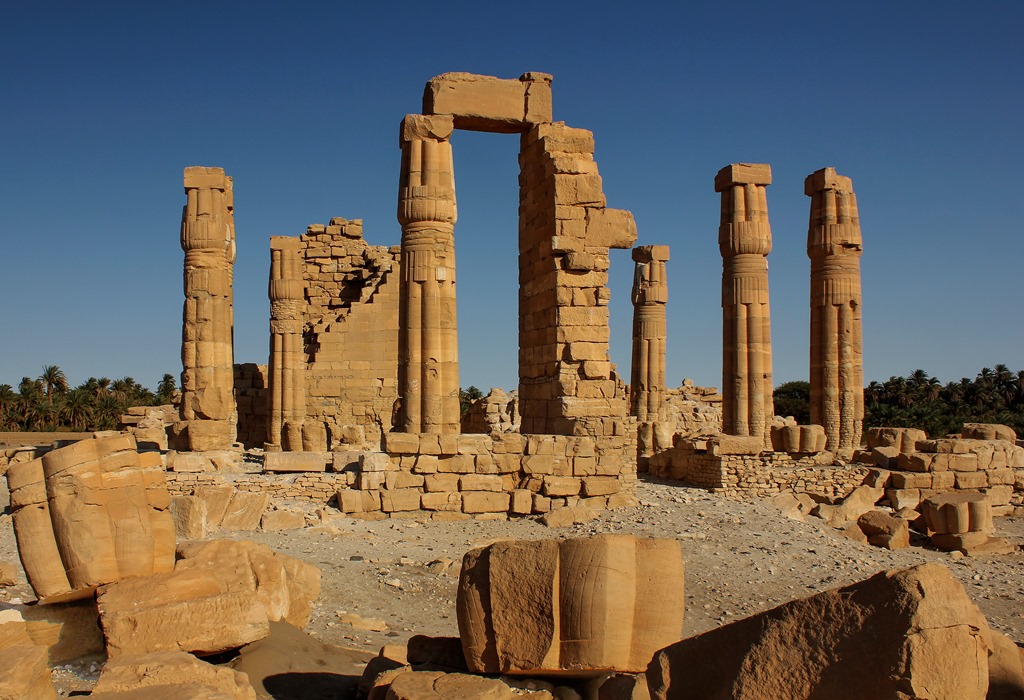
In the traditional narrative and in the collective imagination, Judaism is born all at once, in the thunder of Mount Sinai: one God, one Law, a chosen people breaking with the polytheism of neighbouring nations. But the story written in stone and hidden in the folds of the Hebrew Bible's manuscripts (the Tanakh, attested in the Dead Sea Scrolls from Qumran, 3rd century BCE, and in the medieval Hebrew codices of Aleppo and Leningrad) suggests a far more complex history. The original Hebrew text is not a monolith written by a single hand contemporary with the events, but an imposing stratification of independent sources, often openly at odds with one another1.
Modern historical-critical scholarship in particular (following an influential academic reconstruction championed by scholars such as Frank Moore Cross, Mark S. Smith and Thomas Römer) has isolated two major theological and geographical strands: a northern tradition (rooted in the territories of Canaan and tied to the Canaanite culture of Ugarit) and a southern tradition (originating in the Arabian desert and the nomadic tribes). The Judaism we know is the end result of the gradual convergence, smoothing and editorial harmonisation of these two worlds.
1. The North of El: the supreme god, father of the gods
Reading a Bible translation today, the text seems to speak everywhere of a generic "God" or "the Lord". This, however, is a linguistic illusion produced by later confessional versions, which flattened and standardised under abstract categories the distinct proper names and epithets of the oldest Hebrew codices2.
In texts and traditions attributed to the Northern Kingdom (Israel, or Ephraim), attestations of the deity show a clear predominance of titles and epithets referring to El, rendered in precise epithets such as El Shaddai (El of the Mountains, or the Almighty), El Elyon (El the Most High), or in the majestic plural Elohim3. Archaeological excavations conducted since 1929 at the coastal city of Ugarit (in Syria) unearthed a library of cuneiform tablets from the 2nd millennium BCE that describe the Canaanite pantheon in precise detail4.
At Ugarit, El is the supreme, celestial deity: an old, wise and transcendent god, flanked by his consort Asherah (Athirat). El does not intervene directly in human affairs; he delegates the running of the earthly world to his sons, led by the storm god Baal. Under him preside exactly 70 lesser deities, the bn 'il (the "sons of El"), each assigned to protect one of the 70 nations of the then-known world4.
The Hebrew Bible preserves a trace of this divine council in Deuteronomy 32:8-95. In the medieval Masoretic Text, it reads that Elyon divided the nations «according to the number of the sons of Israel». But the Hebrew manuscript from Qumran, 4QDeutj (dating to the 2nd century BCE), and the ancient Greek Septuagint (3rd-2nd century BCE) preserve the older reading: Elyon fixed the borders «according to the number of the sons of Elohim» (benê 'elōhîm), adding that the portion assigned to YHWH was the people of Jacob, suggesting that YHWH was originally conceived not as the supreme god, but as a deity subordinate to El, who had assigned him a single people.
The imprint of this primordial cult is carved into the very name of the people: Isra-El ("El strives" or "May El rule"), not Isra-Yah. Likewise, the names of the patriarchs, prophets and angels tied to the Northern, more archaic tradition end in -el (Samuel, Ezekiel, Gabriel, Michael, Joel, Daniel), testifying to an era when El was the supreme deity of Canaanite territory.
2. The South of YHWH: the god of the desert
The second tradition has its roots in the South. In the Hebrew texts of the South, the god carries the proper, tetragrammatic name YHWH. YHWH is not born in the urban palaces of Canaan, but among the arid highlands and nomadic tribes of Midian, Edom, Seir and the Sinai desert6. Even Egyptian historical sources confirm this: reliefs at the temple of Soleb (dating to Amenhotep III, 14th century BCE) and at Amarah West bear hieroglyphs mentioning the geography of the nomadic Shasu: ta shasu ya-h-wa, meaning "the land of the Shasu of Yhw"7.
The Hebrew Bible itself preserves the memory of this southern geographical rootedness, referring to YHWH with specific territorial epithets tied to the southern desert: YHWH of Teman, YHWH of Seir, or YHWH of Sinai. The god of the South is explicitly described marching from the southern highlands of Edom to aid his devotees in battle (Judges 5:4 and Deuteronomy 33:2)6.
If the Northern tradition used the theophoric ending -el, the Southern tradition and the Kingdom of Judah signed their prophets, kings and priests with the proper name YHWH, ending in -yah or -yahu13. This is the case for prophets and rulers such as Isaiah (Yeshayahu, "YHWH saves"), Jeremiah (Yirmeyahu, "YHWH exalts"), Zechariah (Zekharyahu, "YHWH remembers"), Hezekiah (Hizkiyahu, "YHWH is my strength") and Josiah (Yoshiyahu, "YHWH supports"). Emblematic is the figure of the prophet Elijah, whose Hebrew name Eli-yahu is a synthesis of this encounter, literally meaning «El is YHWH».
The character of YHWH in the archaic texts of the southern tradition is antithetical to that of the transcendent El. YHWH is a concrete, visible, passionate, anthropomorphic god. The text shows him walking in the garden of Eden in the cool of the day (Genesis 3:8), closing the door of Noah's ark with his own hands (Genesis 7:16), or showing Moses his shoulders and back while shielding him in the cleft of the rock (Exodus 33:21-23).
3. The riddle of Moses
The biblical account of the Exodus reflects the historical memory of this encounter between the desert South and Egypt. The very name of Moses is not Hebrew: it derives directly from the Egyptian root mose or msi, simply meaning "born of" or "son" (present in dynastic names such as Thutmose, "son of Thoth", or Ramesses, "son of Ra")8. When Moses flees to Midian after killing an Egyptian overseer beating a Semitic labourer, in the north-western Arabian region identified by Egyptian sources as the cult centre of YHWH, he meets his wife Zipporah. When Zipporah and the other daughters of the priest Reuel/Jethro return home, they describe Moses to their father by saying, explicitly: «An Egyptian delivered us» (Exodus 2:19).
To understand the historical context in which such a figure belongs, one must look at the religious upheavals of Egypt's New Kingdom. In the 14th century BCE, Pharaoh Amenhotep IV (Akhenaten) carried out a violent revolution: he erased the traditional Egyptian pantheon, shut the temples and centralised worship on the single sun-god Aten, with the political aim of sidelining the powerful priesthood of Amun at Thebes9. When Akhenaten died, his young son Tutankhaten was forced by the priests of Amun to restore polytheism, changing his own name to Tutankhamun. After the young ruler's death, the army general Horemheb seized power as pharaoh and decreed a damnatio memoriae against Akhenaten, erasing his name from official cartouches and dismantling the capital at Amarna.
In this climate of religious purges, the thesis of a link between Atenist monotheism and Moses was proposed by Sigmund Freud in his essay Moses and Monotheism (1939). Although Freud's hypothesis of a literally Egyptian, Atenist Moses has remained a minority position among professional Egyptologists, contemporary scholars of cultural memory such as Jan Assmann have explored the trace left in the historical memory of the Near East by the trauma of the Amarna purge108.
An element pointing to shared priestly training between Moses, Aaron and the court of the Nile lies in the episode of the sacred wonders performed before the monarch (Exodus 7:11-12)11. When Aaron throws down his staff and turns it into a serpent, or turns water into blood, Pharaoh's magician-priests (the härtummîm) perform exactly the same secret rituals. Moses and Aaron appear to have mastered the same liturgical and theurgic techniques taught in Egyptian priestly schools. The biblical text does not deny the existence of other gods, nor the power of their cults, but rather asserts the supremacy of the god who guides Moses, whose staff-turned-serpent swallows those of the rival deities.
In Exodus 4:10 Moses excuses himself before the divine calling, claiming to be «slow of speech and slow of tongue» (and in Exodus 6:12 he speaks of «uncircumcised lips»)11. Traditional rabbinic interpretation has read this passage as a physical stutter, but some scholars suggest that Moses, raised as an aristocrat at the Nile court, simply did not master the Semitic dialect spoken by the common people.
Finally, historical research suggests a measured reading of the alleged mass enslavement. In Exodus 1:11, it is said that the Hebrews were put to work building the store-cities of Pithom (Egyptian Per-Atum) and Rameses (Egyptian Pi-Ramesses)8. Archaeological excavations at Tell el-Dab'a and Qantir have confirmed that these cities in the Nile Delta did exist, and were the site of massive royal building projects under the 19th Dynasty8. However, the Semitic populations present in the Delta, tied to the historical memory of the Hyksos, were in all likelihood resident labourers subject to the royal corvée system12. Had two million slaves fled at once, shattering the Egyptian army, the foreign powers of the era (such as the Hittites or the Canaanite city-states in the Amarna letters) would have widely celebrated and documented Egypt's geopolitical collapse. The silence of neighbouring sources indicates there was no catastrophic collapse, but rather a gradual migration back north of groups of Semitic labourers following a priestly elite breaking with Pharaoh's court12.
4. The mystery of the bridegroom of blood
Among the most archaic and unsettling passages in the entire Pentateuch is a very short episode, embedded in Exodus 4:24-2617, which later theology has long tried to soften. Moses has just received the divine order on the mountain to return to Egypt and free the people. But on the journey back, at a resting place in the desert, something incomprehensible happens:
«At a lodging place on the way, YHWH met him and sought to kill him. Then Zipporah took a flint and cut off her son's foreskin and touched Moses's feet with it, and said, "Surely you are a bridegroom of blood to me!" So YHWH let him alone. It was then she said, "A bridegroom of blood," because of the circumcision.»
The text raises a startling question: why does YHWH try to kill the prophet he has just chosen and sent on a mission? And above all, how did Moses's wife know exactly what was happening and which rite would appease YHWH's wrath, if the law of the covenant had not yet been revealed on Sinai?
Zipporah does not hesitate for a second: she grabs a flint stone (not a metal tool, since the oldest ritual tradition of circumcision preserved the use of stone), circumcises her son, and touches Moses's genitals (in the Hebrew euphemism, "feet") with the blood-soaked foreskin, pronouncing the ritual formula Chatan Damim ("bridegroom of blood"). Only then does God relent and withdraw17.
To explain the episode, biblical criticism turns to the Kenite-Midianite Hypothesis (today among the most credited in scholarly debate, though without unanimous consensus). The biblical text explicitly presents Zipporah as the daughter of Reuel/Jethro, the priest of Midian (Exodus 2:16-21). According to the Kenite-Midianite hypothesis, her family had for generations kept the rites of the desert god at Midian, the original geographic cradle of the cult of YHWH. Moses, having grown up at the Egyptian court, had not been circumcised according to the tribal norm of YHWH. Entering the deity's sacred territory without the mark of the covenant, Moses was regarded by YHWH as a profane outsider to be eliminated. Zipporah, knowing the nature of her father's god, performs an immediate apotropaic act: she uses her son's blood to ritually bind Moses to YHWH, making him a "bridegroom of blood" and saving his life.
The Midianite origin and the originally archaic, non-monotheistic character of this cult also emerge clearly from the later encounter between the Israelites and Jethro in the desert (Exodus 18:11), where the Midianite priest exclaims: «Now I know that YHWH is greater than all gods» (mi-kol ha-elohim). In a purely monotheistic context, this statement would make no sense, since one does not call a deity the greatest if the others do not exist. It is the testimony of a monolatrous, henotheistic phase, confirmed by the First Commandment itself (Exodus 20:3: «You shall have no other gods before me»), which forbids the worship of other deities without denying their ontological existence2.
A detail some scholars read as a further clue, though hardly conclusive, follows immediately after, in Exodus 18:12: during the sacrifice that seals the encounter, it is neither Moses nor Aaron who officiates the rite, but Jethro himself, who brings the burnt offering and sacrifices to God, while Aaron and all the elders of Israel simply join the ritual meal "before God" together with Moses's father-in-law. That a Midianite priest presides over the ceremony, rather than the two Hebrew leaders fresh out of Egypt, has sometimes been read as a possible sign that Jethro was not merely joining someone else's cult, but already held a recognised priestly role toward YHWH; this remains an inference, though, not a settled fact.
5. The Levites: the birth of a priestly caste
The Egyptian legacy and ideological fanaticism converged into a single tribe: the Levites. Among the twelve tribes of Israel, the priestly tribe of the Levites is the only one to preserve several names of credited Egyptian etymology, such as Moses (from Egyptian Msi, "born of"), Phinehas (from Egyptian Pa-nehesi, "the Nubian"), Hophni (from Egyptian Hfnw, "tadpole") and Pashhur (from Egyptian p3 sri n ḥr or pss-ḥr, "son of Horus" or "portion of Horus").
The key episode of rigid priestly fanaticism takes place during the march through the desert: the story of the Golden Calf (Exodus 32)13. Faced with the masses' return to the syncretic cults they had betrayed, Moses gathers the Levites and orders a systematic slaughter: three thousand men (including brothers, friends and neighbours) are massacred by the priests to impose, with blood, the exclusive monotheistic cult of YHWH (Exodus 32:26-28).
Beyond the ideological violence, the Levites brought into the desert a sophisticated ritual culture unknown to the nomads of Sinai, modelled almost entirely on the liturgy of the Nile temples14. Levitical priests were required to wear only pure linen garments (shesh, from the Egyptian term šs), with wool strictly forbidden (Leviticus 6:3)14. This is a telling prescription: wool was the natural fibre produced daily by the desert's nomadic populations through sheep and goat herding, while linen required sowing, cultivation and irrigation on fertile farmland, a resource typical of the Nile valley and entirely impossible to produce in the desert. Mandating linen and excluding wool means the priestly norm did not originate among the Bedouin of Sinai, but was imported directly from the prescriptive sacred dress of the Egyptian priestly caste. Likewise, the daily purification rituals with water, the full-body shaving required of the Levites (Numbers 8:7) and the prohibition on contact with corpses mirror the rules of the Karnak sanctuaries. Finally, the structure of the Tabernacle and the proportions of the Ark of the Covenant are identical to the military encampment of Ramesses II at the Battle of Kadesh and to the gilded wooden shrines found in Tutankhamun's tomb15. Taken individually, these elements do not amount to proof. Taken together, they have been interpreted by some scholars as evidence of a significant Egyptian influence on the formation of the Levitical tradition.
6. The merger of the two traditions
Once settled in the land of Canaan, the Levites consolidated their position. Being the only tribe not to have inherited a geographic territory (Numbers 18:20-24) (perhaps precisely because they arrived later from Egypt, when the other tribes had already settled the area), they secured their economic livelihood by collecting tithes from all the other eleven tribes for cultic services. In the following centuries, this position allowed the priestly caste to vastly expand its political influence.
To unify the people and prevent theological schisms between the cults of the North and the South, the priests carried out a colossal exegetical rewriting. The figures of El and YHWH were unified into a single God. The 70 sons of El became the 70 members of Jacob's family who went down into Egypt (Genesis 46:27), while the figure of Asherah, El's heavenly consort, was systematically erased from the official texts.
The decisive turn toward strict, exclusive monotheism was imposed in 622 BCE under the reign of Josiah in Jerusalem. The text of 2 Kings 22:8 recounts that the high priest Hilkiah, himself a member of the Levitical priestly caste, declared he had "accidentally rediscovered" in the basements of the Temple the "book of the Law" (identified by historians with the core of Deuteronomy)1. In imposing this text, the Levitical priests attempted precisely the same authoritarian operation attempted centuries earlier at Amarna for Aten: the imperial shutdown of all local shrines, the systematic destruction of altars and sacred poles (the Asherim) standing beside them (Deuteronomy 16:21 and 2 Kings 23:6), the elimination of traditional cults, and the absolute centralisation of all liturgical and economic power in Jerusalem.
7. The great harmonisation
Perhaps the memory of the bloody purges and revolts that had erupted centuries earlier in Egypt after Akhenaten's fall was still alive in cultural memory, or perhaps political pragmatism prevailed: whatever the case, the priestly caste and the post-exilic editors carried out an immense work of "cutting, stitching and merging". Instead of abruptly erasing the competing narratives, they wove them into a single, apparently harmonious garment, smoothing over the points of friction, but leaving on the biblical text indelible imprints, logical short-circuits and blatant mythological borrowings.
The editor's admission: YHWH concedes he revealed himself as El
The testimony of this complex work of editorial synthesis is contained in Exodus 6:2-31. Here the priestly redaction inserts a genuine statement of synthesis for the benefit of readers disoriented by the plurality of names in the stories of Genesis:
«God spoke to Moses and said to him, "I am YHWH. I appeared to Abraham, to Isaac and to Jacob as El Shaddai, but by my name YHWH I did not make myself known to them."»
This passage reveals the redactors' strategy: knowing that in the archaic Northern texts and the patriarchal stories God was invoked exclusively by the Canaanite names El or El Shaddai, the redactors insert after the fact a theological explanation that forcibly unifies the cults. In effect, they make YHWH say: "It was me all along, only I hadn't told you my true name yet." It is the decisive move by which the 70 sons of El are reread and reabsorbed into the new monotheistic framework.
The birth story of Moses: a hypothesis of editorial addition
A second intervention concerns the figure of the founder. Many features of the biblical text and several historical clues suggest that Moses may originally have been a figure of Egyptian extraction: he bore a proper Egyptian name (Mose/Msi), spoke the language of the court, making the interpreter Aaron necessary (Exodus 4:10), was described by Jethro's daughters as «an Egyptian» (Exodus 2:19), and mastered the very same theurgic rituals as Pharaoh's priests (Exodus 7:11-12).
According to a widely held hypothesis in historical-critical scholarship, the infancy narrative in Exodus 2:1-10 may represent a later editorial addition. Its main function would not have been merely to give the leader a dramatic origin story, but above all to furnish Moses with a biological Hebrew genealogy, having him born into a family of the tribe of Levi and reinterpreting his Egyptian name through a popular Hebrew etymology (Mosheh, understood as "drawn out of the water")8.
To build this infancy narrative, the scribes applied to Moses the most famous kingship narrative of the ancient Near East: the Legend of Sargon of Akkad (23rd century BCE), inscribed on Neo-Assyrian tablets well known to the Jews in Babylon12. In the Mesopotamian tale, a priestess mother conceives Sargon in secret, places him in a reed basket sealed with bitumen and entrusts him to the waters of the river, where he is rescued and rises to the throne. The scribes of Exodus reused this pattern: Moses's mother hides him for three months, places him in a papyrus basket (tebah) sealed with pitch, and sets him adrift on the Nile.
This narrative modelled on Sargon is the Mesopotamian instance of a much broader shared literary topos: the motif of the "predestined child" saved from the waters and raised in ignorance of his true origins to fulfil a hero's mission. It is a narrative pattern found across countless ancient and modern cultures: from Oedipus to Romulus and Remus, to the nativity accounts of Jesus with the flight into Egypt to escape Herod's slaughter of the innocents, and even in contemporary pop-culture myths such as the story of Superman (sent off in a space cradle as a newborn to escape the destruction of his civilisation, and then raised by an earthly family).
The grafting of this childhood narrative also produces conspicuous short-circuits and anachronisms. The Bible calls Moses's mother Jochebed (Yocheved, Exodus 6:20), a name meaning «YHWH is glory». But when Moses is born, the name YHWH had not yet been revealed to anyone, since, as noted, the revelation of the divine name would only occur much later, when Moses is already an adult on Mount Sinai. This detail may reflect an inconsistency, or a later layer of redaction. Likewise, the story betrays its naively aetiological nature: if Pharaoh had decreed the killing of all newborn Hebrew boys, it is unclear how the elder brother Aaron (only three years older than Moses) (Exodus 7:7) was born and raised freely without the family having had to hide him. But above all, the narrative turn in which the sister Miriam, a young Semitic girl, casually approaches Pharaoh's daughter on the riverbank just as she is fishing the basket out of the water, and promptly offers to hire, as a paid wet-nurse, the very biological mother who had just set the infant adrift, appears entirely naive.
Historical conclusion
The reconstruction offered by modern biblical scholarship and archaeology shows how the birth of Jewish monotheism was the outcome of a long and fascinating historical-cultural process. Judaism did not arise suddenly, nor in isolation from the context of the ancient Near East, but developed through the convergence and stratification of distinct traditions: the transcendent solemnity of the Canaanite El, the energy of the desert god YHWH, the liturgical influences born of contact with Egypt, and the centralising processes promoted by the rulers of Judah in Jerusalem.
This trajectory shows that the sacred texts of antiquity are not immutable monoliths written once and for all, but an extraordinary, plural library that preserves the traces of the eras, social tensions and cultural contexts in which they were born and transformed over the centuries.
A personal reflection
Beyond the historical-critical reconstruction of ancient Near Eastern cults, the dynamic of reworking texts held to be sacred has continued uninterrupted into later religious traditions. A well-known example in Catholic Christianity is the catechetical reorganisation of the Ten Commandments, in which the original biblical prohibition on making carved images of God found in Exodus 20:4 was folded into the First Commandment, and the tenth precept was split into two parts ("do not covet your neighbour's wife" and "do not covet your neighbour's goods") to preserve the count of ten, adapting the ancient biblical structure to the pedagogical and theological needs of the catechism.
Ancient and contemporary history also demonstrates a recurring pattern whenever religious power takes precedence over political power in imposing its own theocracy: from the dark centuries of European history (marked by the devastation of the Crusades, the pyres of the Inquisition and the persecutions of the witch hunts) to events in the contemporary world, such as the turning point of the 1979 Islamic Revolution in Iran, when a rapidly secularising country was transformed into a rigid clerical theocracy stripped of individual freedoms.
Finally, a note on sources. For the sake of practicality, and to allow anyone free and immediate access on the web, in the bibliographic notes I chose to cite open encyclopedic entries directly (such as Wikipedia) or consultable text databases (such as BibleGateway). For those who wish to go deeper on the scholarly level, the historical-critical, philological and epigraphic thread of this inquiry draws on the work of the field's leading contemporary authors and scholars, whom I invite readers to consult: Mark S. Smith, Thomas Römer, John Day, Israel Finkelstein, William G. Dever, Francesca Stavrakopoulou, Frank Moore Cross, Karel van der Toorn and Jan Assmann.
Recognising the historical, human and plural dimension of the Hebrew Bible does not diminish its fascination, but restores it to its most authentic and living nature: that of a grand collective memory that keeps questioning us about our past.
Biblical Passages and Ancient Manuscripts
- Documentary Hypothesis and the Stratification of the Pentateuch: encyclopedic entry and analysis of how the biblical text was formed (sources and textual layers). Read the Wikipedia entry ↩
- Names of God in Judaism and Historical Translations: an in-depth look at the terms El, Elohim, Adonai, and their rendering in the Greek (LXX) and Latin (Vulgate) versions. See the Wikipedia entry ↩
- El (Deity): profile of the supreme celestial deity of the Ugaritic and Canaanite pantheon. Read the encyclopedic entry on El (Wikipedia) ↩
- Canaanite Religion and the Discoveries at Ugarit: an account of the archaeological excavations at Ras Shamra / Ugarit and the divine council of the 70 sons of El. See Canaanite Religion on Wikipedia ↩
- Ancient Witnesses: the Dead Sea Scrolls (4QDeutj) and the Masoretic Text: the Hebrew manuscript 4QDeutj (2nd century BCE) for Deuteronomy 32:8-9, and a critical comparison of the textual witnesses on Wikipedia. ↩
- Ancient Witnesses: Judges 5:4 and Deuteronomy 33:2: the southern origin of YHWH, from the deserts of Seir, Edom and Sinai, in the Hebrew Tanakh. See Judges 5:4 and Deuteronomy 33:2 on BibleGateway and the entry Yahweh on Wikipedia ↩
- The Shasu Nomads and the Soleb Inscription: 14th-century BCE Egyptian epigraphic documentation of ta shasu ya-h-wa. See Shasu on Wikipedia ↩
- Hebrew Manuscripts: Exodus 1:11 and 2:19, the cities of Pithom and Rameses and the figure of an Egyptian Moses in the Tanakh. Read Exodus 1:11 and 2:19 on BibleGateway and the entries Pi-Ramesses and Pithom on Wikipedia ↩
- Atenism and the Reform of Akhenaten: the solar monotheistic revolution at Amarna during Egypt's New Kingdom. Read the Atenism entry on Wikipedia ↩
- Moses and Monotheism: Sigmund Freud's essay on the Egyptian priestly roots of Moses. See Moses and Monotheism on Wikipedia ↩
- Hebrew Manuscripts: Exodus 4:10 and Exodus 7:11-12, the wonders of Egypt's magician-priests and the language of Moses. See Exodus 4:10 and 7:11-12 on BibleGateway ↩
- The Hyksos and the Historicity of the Exodus: archaeological analysis of the corvée system in the Nile Delta and Semitic migration routes. Read Hyksos on Wikipedia and The Exodus on Wikipedia ↩
- Hebrew Manuscripts: Exodus 32, the massacre of the Golden Calf and the imposition of the Levites. Read Exodus 32 on BibleGateway and the entry Golden Calf on Wikipedia ↩
- Hebrew Manuscripts: Leviticus 6:3 and Numbers 8:7, the linen garments and purification rituals of Levitical priests. Read Leviticus 6:3 and Numbers 8:7 on BibleGateway ↩
- The Ark of the Covenant and Egyptian Models: a comparison between the portable shrines of Egypt's New Kingdom and the structure of the Tabernacle. See Ark of the Covenant on Wikipedia ↩
- The Archaeological Site of Kuntillet 'Ajrud: the 8th-century BCE ceramic inscriptions on «YHWH and his Asherah». Read Kuntillet Ajrud on Wikipedia ↩
- Hebrew Manuscripts: Exodus 4:24-26, the "bridegroom of blood" text and the night attack on Moses. Read Exodus 4:24-26 on BibleGateway and the entry Zipporah at the Inn on Wikipedia ↩